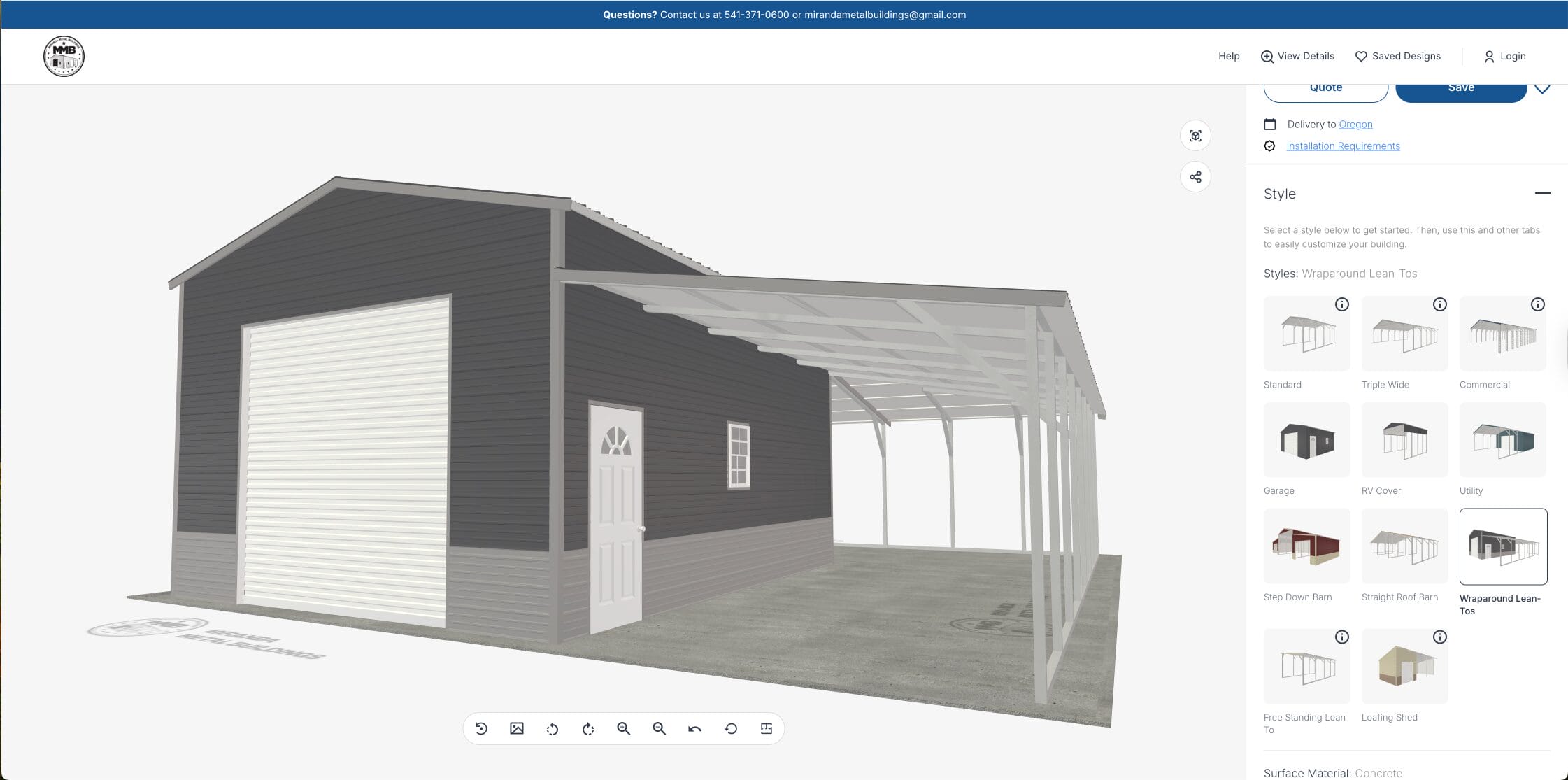


STEP 1
Choose Your Building Type
All building types offer extensive customization options. Whether you prefer fully enclosed structures, open-sided designs, or a combination of both, our flexible approach allows for tailored solutions to perfectly align with your requirements.
STEP 2
DIAL IN THE SIZE
12'-24' (Standard) Common Uses:
-
Small workshops
-
Storage sheds
-
Personal garages
-
Garden & tool sheds
26'-30' (triples) Common Uses:
-
Large workshops
-
Large storage spaces
-
Garages for multiple vehicles
-
Farm Equipment storage
35'-60' (Commercial) Common Uses:
-
Warehouses
-
Industrial workshops
-
Retail outlets & showrooms
-
Large-scale equipment storage
STEP 3
CustomIze Your Building

Colors
Choose from a variety of vibrant colors to match your building to its surroundings or make a statement. Our extensive color options ensure your metal building fits seamlessly into any environment.
ACCESS/LIGHT
Optimize accessibility and natural light with our range of door and window options. Choose from fully enclosed structures for maximum security or partially enclosed designs for added ventilation, tailored to your needs.
-
Walk-In Doors
(34"x72" or 36"x80")
-
Garage Doors (Roll-up)
(6'x6', 8'x7', 9'x7', 10'x8', 10'x10')
-
Windows
(30"x30")
-
Enclosement
Functionality
Structural Options
Enhance the structural integrity and customization of your metal building with additional features. Incorporate gable ends for improved stability and aesthetic appeal. Add extra braces and bows to increase the building's strength and resilience, especially in areas prone to heavy snow or strong winds. For even greater durability, opt for double leg buildings, which provide superior support and longevity. These structural options ensure your metal building is robust, reliable, and tailored to your specific needs.
Height
Customize the height of your metal building to accommodate your specific needs and intended use. Whether you require a taller structure for storing large equipment, housing RVs, or creating additional overhead space for a workshop, our customizable height options ensure your building is perfectly suited to you. Choose from a range of heights to maximize interior space, improve accessibility, and enhance the overall functionality of your metal structure
GAUGE SIZE
Select the gauge size that suits your structural needs, ranging from lighter 29 gauge panels for standard applications to heavier 26 gauge panels for increased durability and strength. We use 2.5”x2.5” galvanized steel tubing with painted welds to seal them from rust, ensuring long-term durability and protection against corrosion. Additionally, choose between sturdy 12 and 14 gauge framing options for added structural support and resilience.
Anchoring
Ensure safety and stability with our grounding options. Our expert team can advise on the best grounding solutions for your location, ensuring your metal building meets all safety standards. We offer a variety of anchoring options, including concrete anchors, ground anchors, rock anchors, and mobile home anchors, to secure your building to your level cement pad, gravel pad, or concrete footings.
Roof Pitch
Tailor the roof pitch of your metal building to optimize aesthetics and functionality. Choose from a range of pitches to suit your climate, architectural preferences, and specific project requirements.
VAPOR BARRIER
Protect your building from moisture and condensation with our vapor barrier options. Our double bubble vapor barrier ensures a dry and comfortable interior, enhancing the longevity and usability of your metal structure.
Insulation
Optimize comfort and energy efficiency within your metal building with customizable insulation solutions. Select insulation materials and thickness levels to regulate temperature, reduce noise transmission, and improve overall comfort for occupants.
Step 4
Before You Build
CERTIFIED OR NON-CERTIFIED
Certified and non-certified buildings offer distinct advantages depending on your needs and location requirements. Certified buildings are engineered to meet specific standards for areas with higher snow loads or wind speeds. These structures undergo additional enhancements such as frame upgrades and bracing to ensure superior strength and safety. While non-certified buildings may be suitable for regions with milder weather conditions, they still provide durable and customizable solutions for various applications.
Site PRep
Effective site preparation is crucial for a successful installation. Please note that we do not handle site preparation and it is the responsibility of the customer. Here are some essential steps to ensure a smooth building installation:
-
Local Building Standards
While it is the customer's responsibility to liaise with local building officials for necessary permits and information. Rest assured, we'll design and install a building that meets all local codes. Please note that certification may be mandated in areas with heightened snow loads or wind speeds. Consideration should also be given to obtaining approval from the HOA, if applicable.
-
Building Site
Please call 811 to have all utilities marked before your building arrives. This will ensure all underground lines will be marked and identified before installation, especially where anchoring will occur.
-
for Installers
Provide a minimum workspace of 2 feet around the entire structure to allow for safe and efficient installation.
-
Powerlines
If overhead power lines are present, maintain a clearance of at least 10 feet or ensure that power lines are completely shut off during installation.
-
Level Foundation
Ensure the land is properly squared and leveled. For more information on leveling requirements, please contact us.
What are Common Mistakes to avoid?
GOT questions?
Discover valuable insights and essential guidance by exploring these comprehensive FAQs, ensuring a smoother journey toward understanding prefabricated steel buildings and their installation process.
General
Prefabricated steel buildings are structures customized for specific locations, built off-site according to detailed specifications provided by the owner and local building authority. We use galvanized steel tubes and 29-gauge panels in various colors. The fabrication process, including welding, bending, and cutting, occurs before delivery, ensuring quick installation of a durable, non-combustible structure that allows for future expansion.
Metal buildings are engineered to last due to their construction with galvanized steel, which resists environmental factors that cause deterioration. Expect your metal building to endure for decades with minimal maintenance.
Constructed from steel, metal buildings exhibit high durability, capable of withstanding various weather conditions such as ice, snow, rain, and extreme heat without issue. Consider the likely weather scenarios in your area when selecting accommodations.
Certified metal buildings should be included in property appraisals, effectively boosting the value of your estate should you opt to sell in the future.
BUilding PRocess
While some locations may exempt smaller carports from permit requirements, failure to obtain one can result in fines or even a mandate to remove the structure entirely. In most cases, particularly with larger metal buildings, it is the customer's responsibility to liaise with local building officials for necessary permits and information. Consideration should also be given to obtaining approval from the HOA, if applicable.
Certification may be mandated in areas with heightened snow loads or wind speeds, but even if not required, opting for a certified building offers numerous benefits.
Certification entails enhancements to a building's safety and strength through the addition of materials such as upgraded frames and bracing. These modifications empower the building to withstand higher wind speeds and snow loads.
Absolutely. Even in remote areas lacking specific building codes, compliance with local regulations is imperative. Obtaining necessary permits and, if required, ordering a certified building are solely the customer's responsibility. Rest assured, we'll design and install a building that meets all local codes.
Installation durations vary based on building size and customizations, typically ranging from a few hours to several days.
Ensure the installation site is as level as possible, ideally comprising a compacted gravel or cement pad. Additional labor costs may arise if extra materials or adjustments to the legs are necessary for proper leveling.
Anchors, affixed to the base rails of metal buildings, secure the structure deep into the ground. Different anchor types suit various installation sites.
For ground or asphalt installations, we utilize 32-inch rebar anchors. Certified ground and asphalt installations feature double helix mobile home anchors. Mobile home anchors, at an additional charge, are applicable for non-certified ground installations. Concrete installations utilize wedge anchors.
We offer and recommend installing a double bubble vapor barrier on all building roofs to prevent interior condensation. Full building insulation is available upon request.
Certainly! Our buildings are available for self-installation. You have the option to either pick up the materials yourself or have them delivered, catering to customers who prefer DIY projects.
Payment
Additional charges may apply for return trips or installation delays due to ill-prepared sites. Fees might also be incurred for installations over existing structures, on unlevel sites, decks, elevated retaining walls, or other special circumstances. These fees are evaluated case by case, including any material transportation exceeding 50 feet by foot.
A deposit is required upon ordering (preferably via cashier's check, money order, or credit card with a 3% fee), with the balance due upon installation via cashier's/certified check or money order.
Installation timelines typically span around 2 weeks for non-certified buildings, with an additional 2 weeks for certified ones, contingent upon building size and customization.